Culture
From Ahmedabad to Paris: The Indian Craft Story Behind Dior Fall Winter 2026-2027 Haute Couture
Jonathan Anderson’s first haute couture collection for Dior Fall Winter 2026-2027 was more than an exploration of sculptural fashion. It was also a quiet acknowledgement of India’s enduring influence on the evolution of luxury craftsmanship.
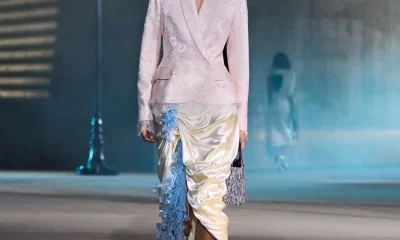
For Dior Fall Winter 2026-2027 Haute Couture, Anderson built the collection around the work of American sculptor Lynda Benglis. Known for transforming flat materials into fluid, three-dimensional forms through folding, knotting and moulding, Benglis offered a natural parallel to haute couture itself, where fabric becomes sculpture through the hands of artisans.
That philosophy shaped the collection. Hand-plissé, draping and intricate knotting became the defining design language, placing craftsmanship ahead of embellishment and reminding audiences that couture’s greatest luxury remains the human hand.
The most compelling narrative, however, lay in Benglis’ long association with Ahmedabad, Gujarat.
Her celebrated Peacock series, inspired by the birds she encountered while living in Ahmedabad during the late 1970s, reappeared through vibrant floral embroideries and beaded embellishments across the collection. Rather than treating India as a decorative reference, Anderson used it as a starting point for deeper historical research.
That journey led him to one of India’s most significant textile contributions: chintz.
These hand-painted and block-printed cottons, produced in India during the eighteenth century, fundamentally influenced European decorative arts and textile design. Dior acknowledged that legacy by incorporating antique fragments of Indian chintz and indiennes onto Petit Dîner and Mini Lady Dior bags, subtly recognising that European luxury has long been shaped by Indian craftsmanship.
This distinction matters. Luxury fashion is gradually moving beyond borrowing visual motifs toward recognising the histories that produced them. Instead of presenting Indian craft as an exotic influence, Dior positioned it as part of the foundation upon which European luxury evolved.

The collection reinforced this dialogue through colour, balancing Ahmedabad’s lush botanical landscape with the dry, crystalline environment of Santa Fe, New Mexico, where Benglis also works. The resulting palette reflected contrasting geographies while maintaining a cohesive sculptural vision.
While Anderson reinterpreted Dior’s iconic Bar Jacket and New Look silhouette with softer construction, asymmetry and architectural draping, the collection never relied on nostalgia. Heritage became material for experimentation rather than preservation.
For the wider fashion industry, the message is clear. Couture’s future is increasingly being defined not by spectacle, but by process. Construction, handwork and cultural research are becoming as valuable as silhouette or embellishment.
For India, the collection carries an equally important implication. As luxury houses invest more deeply in textile history, Indian craft is no longer being recognised simply for its artisanal beauty, but for its role in shaping the very language of global luxury.
Jonathan Anderson’s Dior did not merely reference Ahmedabad. It quietly reminded Paris that some of luxury’s most enduring stories began there.