Lifestyle
The Controversy Behind Ralph Lauren’s High-Priced ‘Bandhani’ Skirt
The controversy surrounding Ralph Lauren and its recent “Bandhani-inspired” skirt has struck a deeper chord in India than a typical fashion controversy. This is not just about design influence or global inspiration, it touches something far more personal, the erasure of craft identity.
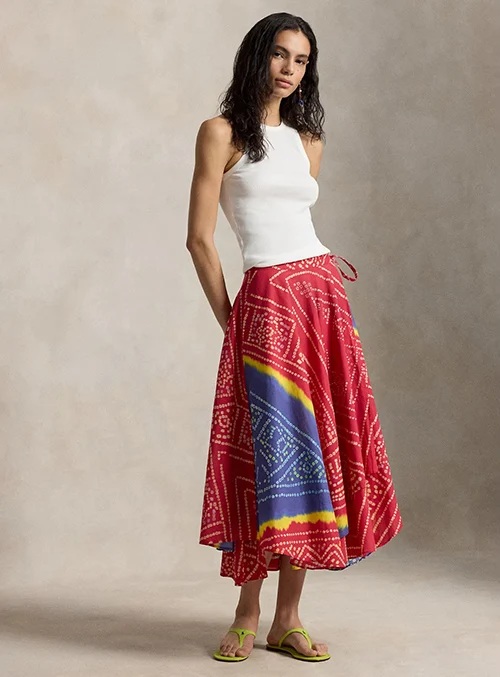
At the center of the debate is a wrap skirt priced at approximately ₹44,800. The piece draws clear visual reference from Bandhani, a centuries-old textile tradition rooted in Gujarat and Rajasthan. But what has unsettled many is not the inspiration itself, it is how that inspiration has been translated.
Bandhani is not a surface-level aesthetic. It is a process that involves painstaking handwork, where artisans tie thousands of knots before dyeing the fabric to create its signature patterns. It carries cultural memory, regional identity, and generational skill. In comparison, the Ralph Lauren skirt appears to be a printed version, visually similar but fundamentally disconnected from the craft it references.
The brand does mention “Bandhini tie-dye techniques” in its description. But it stops there. There is no direct acknowledgment of India, no reference to the artisan communities, no context that grounds the design in its cultural origin. Instead, the language leans toward vague descriptors like “vintage-inspired” and “vibrant design,” effectively stripping the craft of its identity.
And this is where the discomfort begins.
Because for Indian audiences, Bandhani is not just a pattern. It is something lived, worn, inherited, and passed down. Seeing it reframed as a generic luxury print, without context or credit, creates a sense of displacement, as if the story has been taken but the storytellers have been left behind.
The pricing only intensifies this tension. Authentic Bandhani pieces, made through days of labor, are available across India at far lower price points, often directly supporting the artisans who sustain the craft. When a mass-produced interpretation is positioned at a global luxury price, the question naturally follows, what exactly is being valued?
This is not the first time Ralph Lauren has faced such criticism. Earlier this year, the brand was called out for presenting traditional Indian Jhumka earrings as generic “vintage earrings” on an international runway. And it is not alone. Brands like Prada and Dior have faced similar scrutiny for referencing South Asian crafts without clear attribution.
What is becoming evident is that this is no longer viewed as isolated oversight. It is being read as part of a larger pattern within the luxury industry, one where cultural elements are borrowed, aestheticized, and commercialized, often without bringing visibility back to their origins.
What has changed now is the audience.
Digital platforms have amplified voices across India, from designers to cultural commentators, who are increasingly unwilling to let these moments pass quietly. The conversation is no longer limited to whether something is “inspired.” It is about whether it is acknowledged, contextualized, and respected.
Because today, inspiration alone is not enough.
In a global fashion system that thrives on storytelling, leaving out the origin of that story is no longer a minor gap. It is the very thing people notice first.
And perhaps that is the real shift this controversy represents.
Bandhani is not just a design reference to be reinterpreted.
It is a legacy. And for many in India, that legacy deserves more than a passing mention, it demands to be named.