Business
Is Indian Couture Becoming Saturated, or Is the Industry Entering a More Narrative-Driven Luxury Economy?
Indian couture and occasionwear industry is no longer operating purely as a fashion category. It is increasingly behaving like a complex luxury economy shaped by wealth expansion, digital visibility, retail corporatisation, social-media algorithms, and changing consumer psychology.
At first glance, the Indian couture ecosystem appears overcrowded. New bridal labels emerge almost weekly, celebrity-led occasionwear dominates social feeds, and visual similarities across the market have triggered growing industry conversations around design fatigue and creative repetition.Yet beneath that surface-level perception lies a very different economic reality.
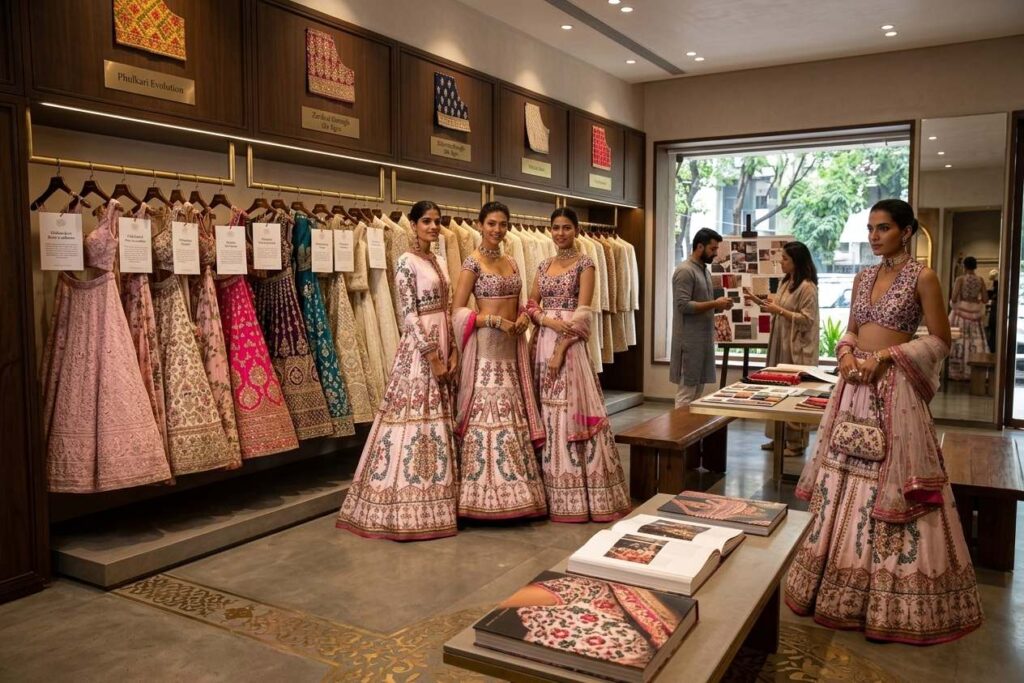
India’s luxury market is projected to touch nearly $200 billion by 2030, growing at close to a 12% CAGR. Within that, the Indian wedding and couture economy alone is estimated between $50 billion and $75 billion annually, making it one of the largest ceremonial fashion markets globally.
At the same time, India’s ultra-high-net-worth individual population is expected to rise by nearly 58.4% between 2023 and 2028, creating an expanding consumer base for hyper-exclusive luxury and couture services.This widening luxury consumer class is precisely why designer Shourya Jain of SHOURYA GATHA rejects the idea that Indian couture is truly saturated.
“I wouldn’t call India, a hub of couture, saturated,” the brand shared during a recent Fashion Herald industry discussion. “Yes, we have a lot of options in the market, but to cater to a population this large, even these many designers fall short.”
That distinction is important because the current market tension may not actually be oversupply. Instead, the industry appears to be experiencing what many insiders privately describe as aesthetic compression.
The rapid acceleration of Instagram-led luxury visibility has created a system where commercially validated visual formulas outperform slower creative experimentation. As a result, multiple labels often begin converging toward the same silhouettes, embroidery structures, bridal palettes, and celebrity-approved visual codes.This is not merely a creative issue. It is also a financial one.
Customer acquisition costs across Meta platforms for Indian luxury and premium fashion brands have reportedly increased by nearly 40% to 50% over the last three years. For emerging designers already operating within thin margins, failed experimentation carries significant economic risk.
In practical terms, this means commercially recognisable designs mathematically convert better than unfamiliar visual languages.The result is an algorithm-driven homogenisation cycle where designers increasingly optimise for instant visual validation rather than long-form emotional storytelling.Shourya Jain believes this behavioural shift has fundamentally altered how couture is consumed.
“Indian designers are definitely recognising the power of a strong narrative while marketing their designs,” the label explained. “However, the Indian consumer still largely relies on the visual appeal of a garment at first glance rather than its elaborate backstory.”
That observation reflects the realities of contemporary digital luxury consumption.
The average viewing time on a luxury fashion social-media post is now estimated at less than 2.5 seconds. Within that timeframe, garments are expected to deliver immediate visual impact before any deeper narrative can even register.
This has created a structural imbalance within Indian luxury storytelling. Brands increasingly speak the language of narrative, heritage, emotion, and craftsmanship, yet most consumer engagement continues to be driven by immediate aesthetic recognition.
“I think there lies a lesson for us designers,” Shourya Jain added. “We need to work harder on visual storytelling rather than only relying on the textual stories we weave into Instagram captions.”
That statement highlights one of the most important shifts currently taking place within Indian couture: the transition from descriptive storytelling to embedded storytelling.Luxury consumers, particularly younger ones, increasingly expect emotional identity to be visible within the garment itself rather than explained externally through campaign copy.
By 2026, Millennials and Gen Z are expected to account for more than 60% of India’s luxury consumer base. Multiple luxury studies also indicate that nearly 72% of younger luxury consumers are willing to pay a premium for brands associated with authentic craftsmanship, emotional storytelling, and transparent production ecosystems.
However, this same demographic is also becoming increasingly sceptical of superficial brand narratives. Nearly 85% of younger luxury consumers globally claim they can identify “story-washing” or artificial storytelling used primarily for marketing optics.
This is precisely where Shourya Jain positions its own design philosophy.
“I often pick silhouettes, motifs, and crystals that can feel intimidating and carry a strong, distinct presence; honestly, it’s not for everyone. Doing that takes courage, valour.” “At the same time, romance is the second identity of my design language. Everything I design has to come from a place of endearment. It’s a perfect yin and yang.”
This movement toward emotional architecture within design reflects a broader transformation happening inside Indian couture. Increasingly, labels are attempting to build symbolic universes rather than simply occasionwear collections. Yet the deeper structural challenge lies beyond storytelling. It sits within the condition of India’s craft ecosystem itself.
India’s handicraft and handloom sector employs more than seven million artisans, making it one of the largest craft economies globally. Despite this scale, the sector remains deeply fragmented, with studies historically showing that only 10% to 15% of the final retail price of luxury garments reaches artisans and master weavers.
For Shourya, the larger concern is not simply preservation, but stagnation.
“A major reason many art forms are rapidly declining is because artisans often refuse to evolve. The same motifs, same placements, same colourways.There is a difference between vintage and outdated, and many of our precious crafts are fading because they have remained visually unchanged for decades.”
That criticism enters sensitive territory within Indian luxury fashion, where craft preservation has often been treated as an unquestionable virtue. However, global luxury history suggests that preservation without evolution eventually weakens cultural relevance. The issue becomes even more pronounced when compared against global luxury infrastructure.
Major international luxury conglomerates such as LVMH and Kering invest between 2% and 4% of annual revenue into research, development, textile innovation, and artisanal experimentation. By contrast, large portions of India’s unorganised couture ecosystem reportedly spend less than 0.5% on genuine textile R&D and craft innovation.
This innovation gap has widened further following the increasing corporatisation of Indian luxury fashion.Over the last few years, conglomerates such as Reliance Brands Limited and Aditya Birla Fashion and Retail Limited have acquired stakes in some of India’s most influential couture houses, including businesses linked to designers such as Sabyasachi Mukherjee, Manish Malhotra, and Tarun Tahiliani.
This corporate consolidation has dramatically shifted access to capital, manufacturing, retail infrastructure, and innovation bandwidth across the industry.
Today, top-tier corporate-backed luxury labels are estimated to command over half of India’s couture luxury market share, while independent and emerging designers increasingly compete inside high-pressure visibility ecosystems with limited financial cushioning.
Shourya Jain directly addressed this imbalance. “Only magnum designers often have the dedication and financial bandwidth to invest in developing new design languages, which naturally leads to bigger price tags and, unfortunately, the rise of replicas that don’t truly benefit the artisan community.”
That replica economy itself has become a parallel industry.
India’s counterfeit and grey luxury fashion market is reportedly growing at nearly 15% CAGR in certain segments, in some cases even outpacing authentic luxury growth within aspirational categories. The rise of “screenshot shopping” has accelerated this phenomenon. Viral couture garments are routinely replicated through manufacturing hubs such as Surat and Chandni Chowk, allowing consumers to purchase near-identical visual interpretations for a fraction of the original price.
This creates a difficult commercial cycle for emerging labels. Without the brand authority of legacy couture houses, experimentation becomes harder to monetise, pushing younger businesses toward safer imitation-driven models.
“Budget labels and emerging designers are then naturally pushed toward imitation rather than investing in original design development,” Shourya Jain noted, “because their names alone are not yet powerful enough to sell experimentation.”
Perhaps the most strategically important insight from the discussion, however, was not about couture itself, but about innovation ownership.
“Imagine if design innovation happened at the artisan level, which is how these art forms originally evolved. Entire communities could benefit from it.” That idea fundamentally reframes the future of Indian luxury.
Historically, Indian craft ecosystems evolved because artisan communities themselves continuously experimented with motifs, structures, weaving techniques, dyeing systems, and symbolic aesthetics. Over time, however, many crafts became commercially frozen into static heritage identities designed primarily for preservation rather than evolution.
If Indian couture is to genuinely compete within the next era of global luxury, the conversation may need to move beyond surface-level storytelling and toward systemic reinvestment in creative development across the supply chain itself. Because ultimately, the defining challenge facing Indian couture may not be saturation at all.
It may be whether the industry can evolve from a visibility-driven occasionwear economy into a truly innovation-led luxury ecosystem capable of generating new visual languages at scale.