Celeb Style
Tamara Ralph Cannes 2026 Dominance Signals the Return of Architectural Glamour
At the Cannes Film Festival, few designers shaped the visual language of the red carpet as decisively as Tamara Ralph. Across multiple celebrity appearances, Ralph established a clear couture narrative, one rooted in sculptural bodices, fluid movement, and a recalibrated version of classic Hollywood glamour that feels increasingly aligned with the current luxury mood.
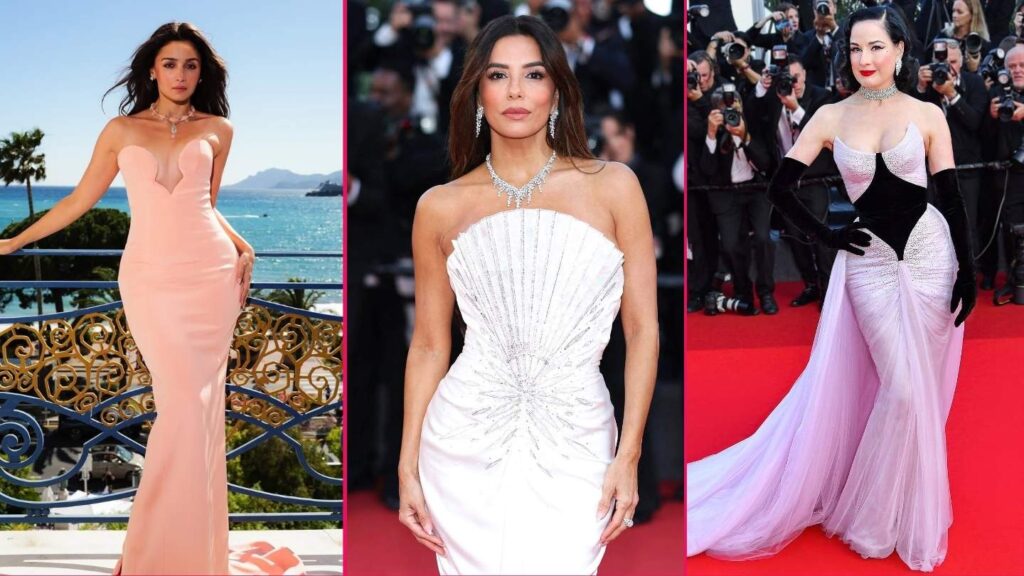
While recent red carpet dressing has oscillated between minimalist restraint and overt archival nostalgia, Tamara Ralph’s Cannes presence pushed toward something more cinematic. The gowns were unapologetically formal, but strategically controlled in execution. Rather than relying on excessive embellishment, the focus remained on silhouette engineering and architectural construction.
The strongest recurring theme across Ralph’s Cannes lineup was the dominance of the bodice as the visual anchor. On Alia Bhatt, a blush-toned strapless gown balanced a sharply structured neckline against an otherwise sleek, elongated silhouette, softened only through the addition of a sweeping chiffon cape. The look reflected Ralph’s growing ability to merge contemporary restraint with old-Hollywood drama without overwhelming the wearer.
A similar construction philosophy appeared on Eva Longoria, whose white satin gown became one of the festival’s defining couture moments. Here, the pleated fan-like bodice functioned almost as wearable sculpture, radiating outward into fluid satin draping and an extended train. The precision of the upper structure contrasted intentionally with the softness of movement below, a technique that became central to Ralph’s overall Cannes aesthetic.
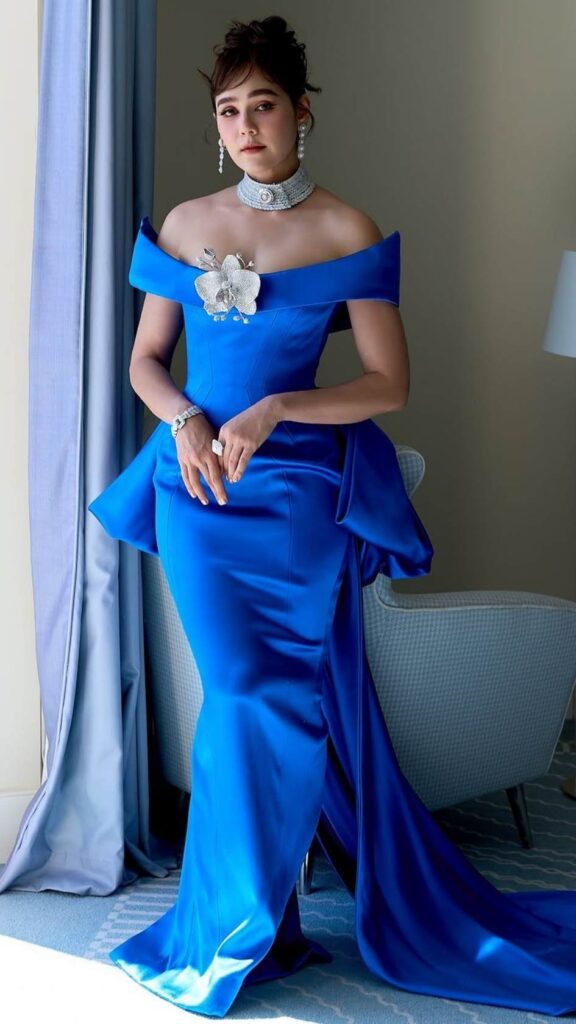
The same tension between rigidity and fluidity appeared again on Dita Von Teese and Araya A. Hargate, though interpreted through very different visual languages. Von Teese’s monochromatic gown introduced sharper graphic contrasts and noir theatricality, while Hargate’s electric blue satin look leaned into exaggerated peplum structures and high-impact color theory. Despite the variation, both reinforced Ralph’s signature approach: controlled structure offset by dramatic motion.
What makes this particularly relevant from an industry perspective is how closely it aligns with the broader shift happening in couture and celebrity dressing. After several seasons where “quiet luxury” dominated both retail and red carpet conversations, Cannes 2026 suggested a renewed appetite for visible glamour, but with sharper tailoring and intentional construction replacing excessive ornamentation.
Tamara Ralph understands this balance exceptionally well. Her gowns deliver spectacle without visual chaos. Embellishments are concentrated rather than overwhelming, often placed strategically at focal points instead of covering entire garments. This restraint allows craftsmanship and silhouette to drive the impact, a significant distinction in an era where red carpet imagery is consumed instantly across digital platforms.
The result is couture designed not just for physical presence, but for image longevity.
At Cannes 2026, Tamara Ralph did more than dress celebrities for premieres. She established one of the festival’s clearest aesthetic directions, proving that architectural glamour, when executed with precision and softness in equal measure, still holds immense power on the modern red carpet.