Culture
The Geometry of Grace: The Authentic Indian Paithani Weave in Modern Couture
Long before “quiet luxury” became fashion’s favorite buzzword, Paithani had already mastered the concept.No screaming logos. No trend-driven embellishment. Just silk, zari, geometry, and a level of craftsmanship that machines still struggle to imitate.
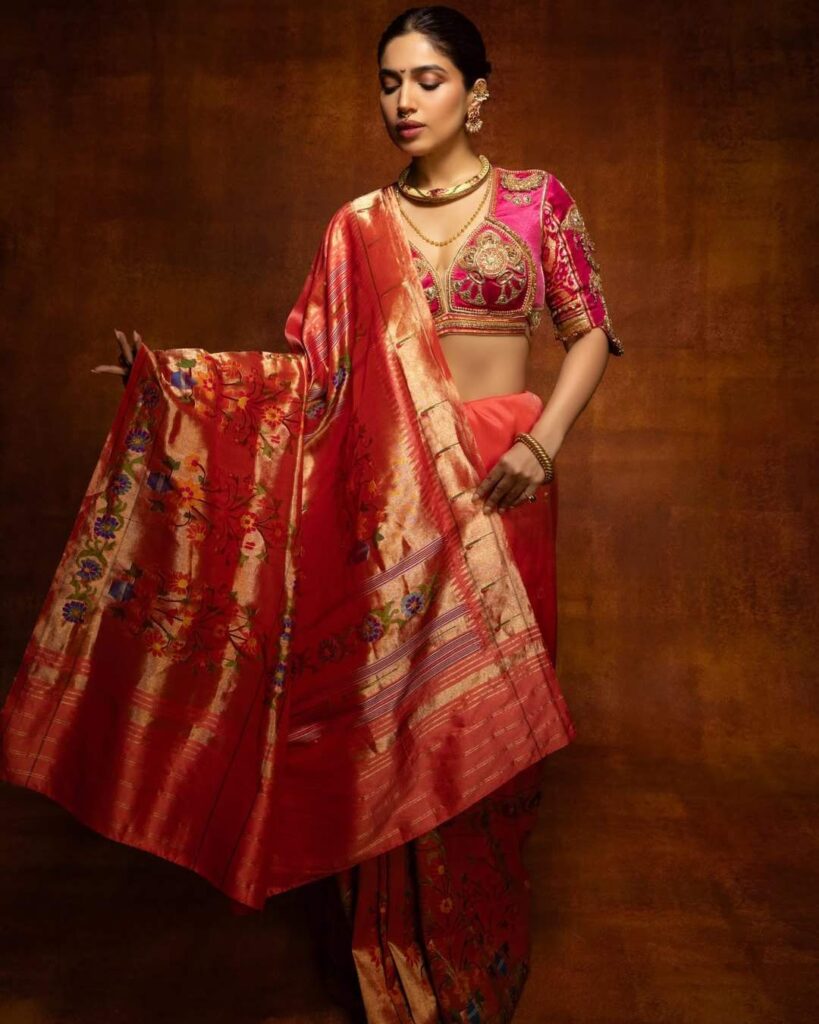
Originating from Paithan, the centuries-old weave was once reserved for Maharashtrian royalty and aristocratic households. Today, it is finding a completely new audience: luxury collectors, Gen Z fashion enthusiasts rediscovering heritage dressing, and designers treating Indian textiles as investment-level couture rather than occasionwear alone.
But as Paithani gains renewed visibility, another conversation is emerging alongside it, authenticity.Because in today’s market, identifying a real handwoven Paithani has become harder than ever.
Why Paithani Suddenly Feels Relevant Again
Fashion is currently obsessed with craft credibility.Globally, consumers are moving away from disposable luxury toward pieces with visible human labor attached to them. The rise of archival fashion, slow craftsmanship, and heritage textiles has created the perfect environment for Paithani’s comeback.
Unlike trend-based embroidery cycles that fade seasonally, Paithani carries permanence. Its appeal comes from structure, technique, and cultural memory.
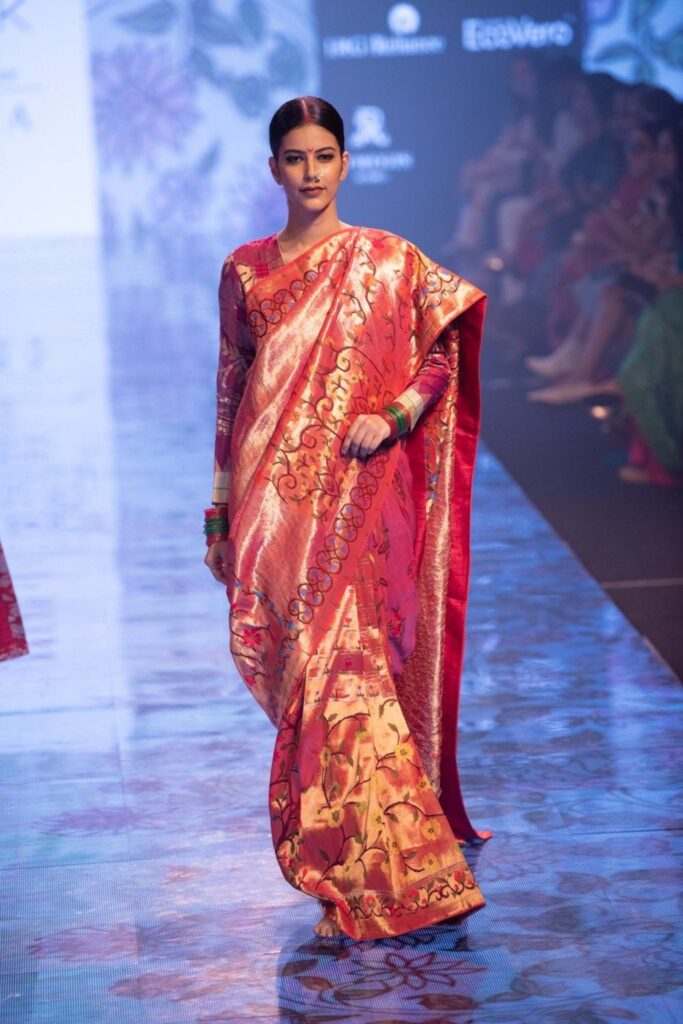
For younger consumers especially, the weave sits at an interesting intersection. It offers the nostalgia of traditional Indian dressing while still feeling visually dramatic enough for modern fashion storytelling, particularly in an era dominated by vintage revival aesthetics across social media.
And unlike many commercial festive textiles, authentic Paithani photographs with depth. The zari reflects differently under movement, the motifs appear dimensional rather than flat, and the drape holds architectural sharpness that immediately separates it from synthetic replicas.
That visual richness is precisely why stylists and luxury designers continue returning to it.
The Real Luxury of Paithani Lies in the Backside
The easiest way to understand authentic Paithani is surprisingly simple: flip it over.
A genuine handwoven Paithani uses an interlocking tapestry weaving technique where motifs are woven directly into the fabric rather than embroidered or printed afterward. This creates a nearly identical finish on both sides, without loose floating threads.That technical detail is what transforms Paithani from decorative textile into weaving mastery.
Every peacock, lotus, vine, and Munia parrot is constructed thread by thread through manual interlocking. The process requires immense precision because even slight tension variations can distort the symmetry of the motifs.
In weaving terms, Paithani is incredibly unforgiving.Which is also why authentic versions take months to complete.
The complexity becomes especially visible in heritage pallus featuring dense zari work and multi-colored motifs. Unlike power-loom replicas that prioritize speed and uniformity, handwoven Paithani carries tiny irregularities that reveal the presence of the artisan’s hand.
Ironically, those imperfections are now considered the real markers of luxury.
The Motifs Are More Than Decoration
Paithani’s motifs function almost like textile signatures.The Munia parrot, perhaps the weave’s most recognizable detail, traditionally symbolizes prosperity and fertility. The lotus references spiritual abundance, while elaborate peacock motifs became associated with royal patronage across Maharashtra.
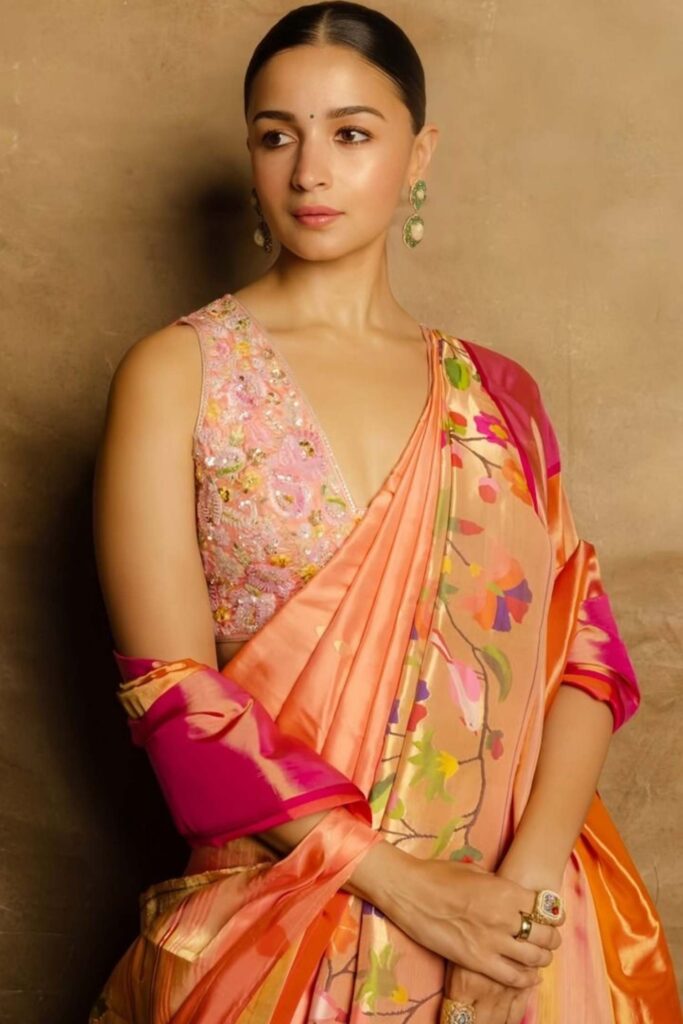
Historically, many of these designs were inspired by temple architecture, mural paintings, and local flora. But today, they also serve another purpose: helping distinguish authentic weaving traditions from mass-produced imitation.
Power-loom versions often flatten these motifs into repetitive decorative patterns. Handwoven Paithani, however, retains visual depth because each motif is individually constructed rather than mechanically replicated.That distinction matters more now than ever.
The Business Problem Nobody Talks About
Paithani’s popularity has created a paradox.The more desirable the weave becomes, the more aggressively the market floods with cheaper machine-made copies.
For consumers, the difference is often difficult to identify at first glance. Many replicas mimic traditional motifs, use metallic yarn substitutes, and imitate heritage color palettes convincingly enough for social media visibility.But within the textile industry, the consequences are serious.
Machine-made Paithanis compress months of artisanal labor into mass production cycles, dramatically undercutting handloom weavers. More critically, they reduce centuries of weaving intelligence into surface aesthetics.This is why designers and textile revivalists are increasingly vocal about authenticity preservation.
How Designers Are Reframing Paithani for Modern Fashion
The new generation of Indian luxury fashion is no longer treating handloom as costume dressing.Instead, designers are positioning textiles like Paithani as couture material with contemporary relevance.
Gaurang Shah has consistently advocated for preserving authentic weaving traditions, openly criticizing copied Paithani designs and the dilution caused by power-loom reproductions. His work emphasizes direct collaboration with artisan clusters and painstakingly handwoven textiles that preserve the integrity of the craft.
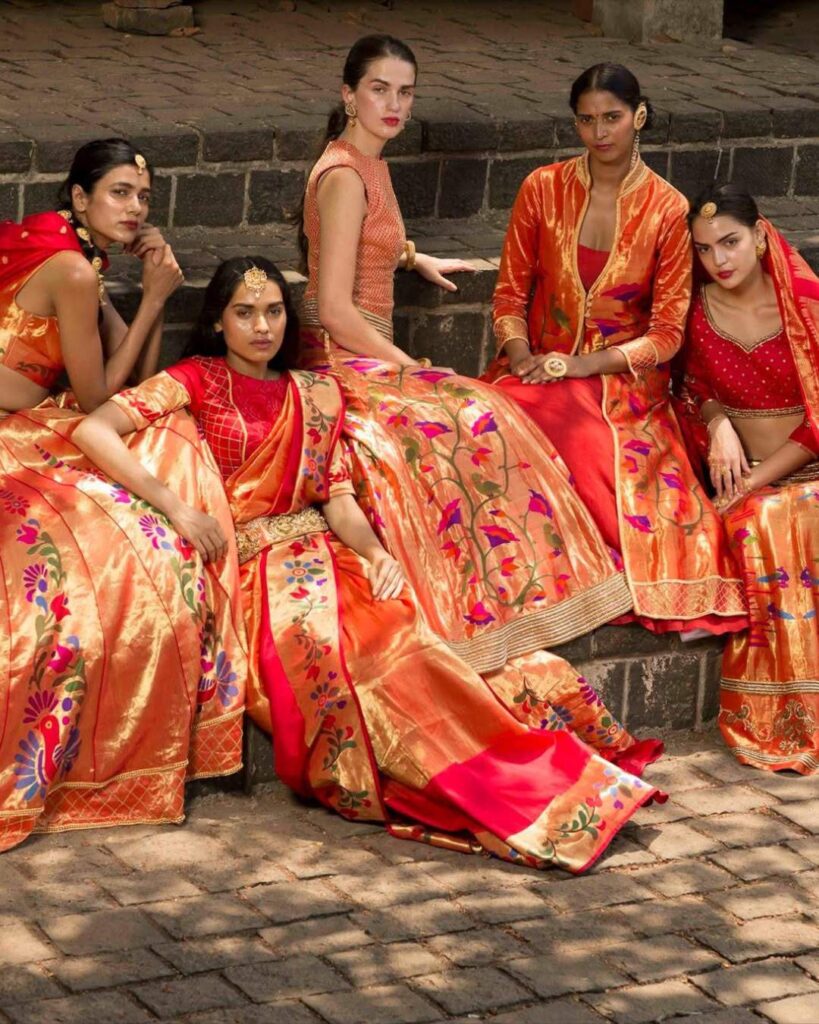
Meanwhile, Harshita Chatterjee Deshpande has been revisiting archival weaving references and forgotten Paithani motifs, helping restore regional specificity to contemporary fashion narratives.The approach signals a larger industry shift.
Indian fashion is moving beyond generic “heritage inspiration” and entering a phase where textile research itself is becoming a luxury language.
Why Celebrity Styling Keeps Returning to Paithani
Few textiles balance old-world glamour and modern styling as naturally as Paithani.
At the MaTa Sanman Awards 2026, Bhumi Pednekar wore a richly woven Paithani silk ensemble by Pankaj S Heritage that perfectly demonstrated how the weave adapts to contemporary couture aesthetics. The elaborate Asavali pallu, detailed with Akroti floral motifs and dense zari work, retained its regal Maharashtrian identity while still feeling fashion-forward.
Similarly, Alia Bhatt’s Paithani look by Abu Jani and Sandeep Khosla softened the traditional visual language through pastel tones, minimalist styling, and a sharply contemporary blouse silhouette.The styling shift matters.
Instead of overwhelming the weave with heavy accessorizing, modern celebrity dressing allows the textile construction itself to become the statement.That restraint is exactly what makes Paithani feel current again.
Paithani Is No Longer Just Heritage. It’s Fashion Capital.
The future of luxury fashion increasingly belongs to craftsmanship that cannot be industrially replicated.And that is precisely where Paithani holds power.Its value no longer comes only from cultural nostalgia or bridal tradition. It comes from scarcity, technical labor, and authenticity in a market oversaturated with imitation.
For Gen Z consumers entering luxury fashion through the lens of sustainability, craftsmanship, and identity-driven dressing, Paithani offers something rare: emotional heritage with collectible value.For the business side of fashion, it represents something even bigger.
Proof that Indian handloom, when protected properly, can operate not as souvenir craft, but as global luxury.