Runways
Navdhara Khadi at Lakmé Fashion Week x FDCI FW26: Rewriting the Narrative of India’s Most Symbolic Fabric
At Lakmé Fashion Week x FDCI, the Khadi conversation took a decisive turn. “Navdhara,” presented by Khadi and Village Industries Commission, wasn’t positioned as a nostalgic tribute,it was a strategic reset.
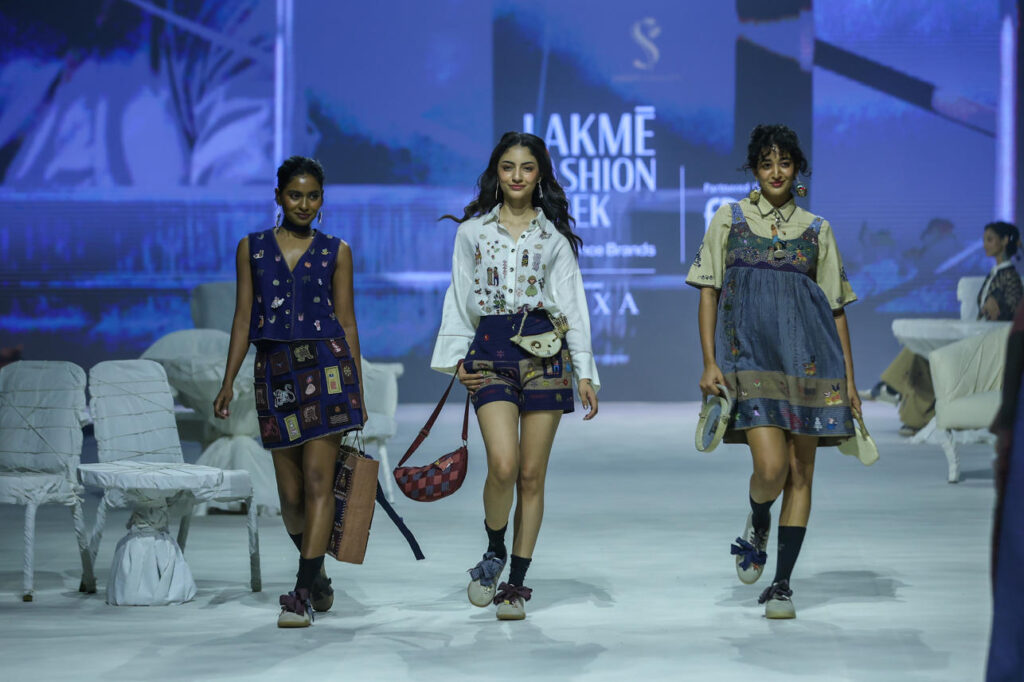
Held at the Jio World Convention Centre, the showcase brought together Samant Chauhan, Pawan Sachdeva, Shruti Sancheti, and CoEK–Khadi India in a tightly curated attempt to answer a question the industry has been quietly circling for years: can khadi move beyond symbolic relevance into a scalable, design-led category?
The answer, at least visually, is no longer theoretical.
Khadi’s Identity Shift: From Freedom Fabric to Design Commodity
For decades, khadi has been burdened with meaning—freedom, austerity, sustainability. As Sunil Sethi reiterated, it is “metaphorical.” But metaphor doesn’t sell garments at scale. Design does.
Navdhara’s core insight lies here: reposition khadi not as an ethical choice, but as a design material capable of competing with global textiles on texture, versatility, and finish.
This is a critical pivot. Because until khadi is seen as desirable—not just respectable—it remains commercially limited.
Samant Chauhan: Silk Route as a Modern Luxury Proposition
Samant Chauhan’s approach was arguably the most commercially aligned with global luxury. By drawing from the Silk Route and working with Bhagalpur silk, he introduced a tactile richness often missing in mainstream khadi narratives.
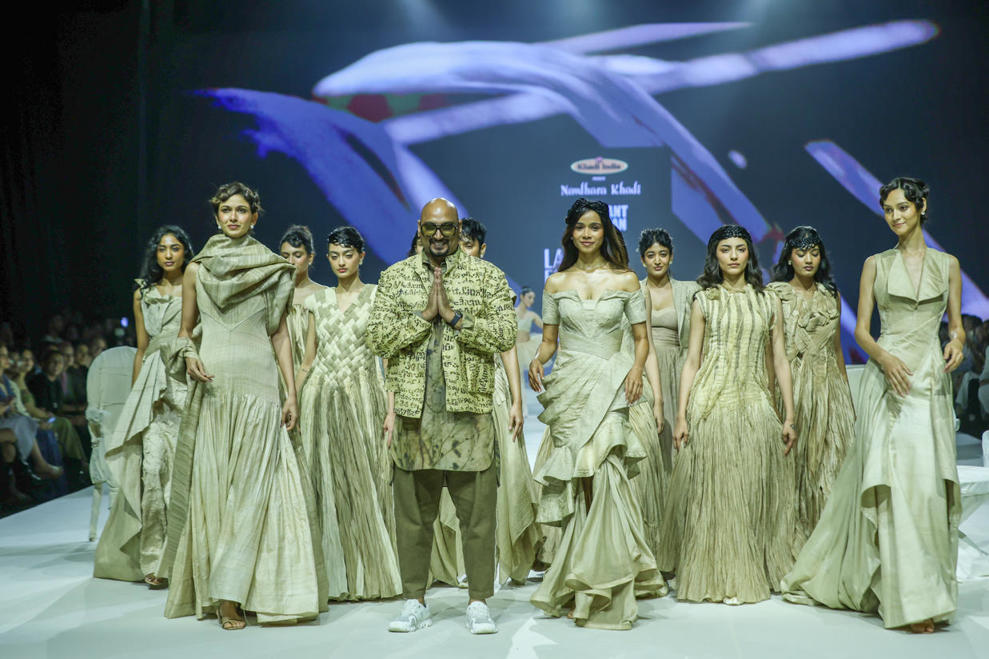
The focus on texture variation within a single look signaled something important: khadi doesn’t need embellishment to feel premium—it needs construction intelligence. The silhouettes stayed contemporary, avoiding the predictable “craft showcase” trap.
For international buyers, this is the closest khadi has come to entering a translatable luxury vocabulary.
CoEK–Khadi India: System-Built Craft, Not Designer-Led Storytelling
The CoEK presentation, “Saumy,” backed by KVIC and NIFT, functioned less as a designer showcase and more as a systems demonstration.
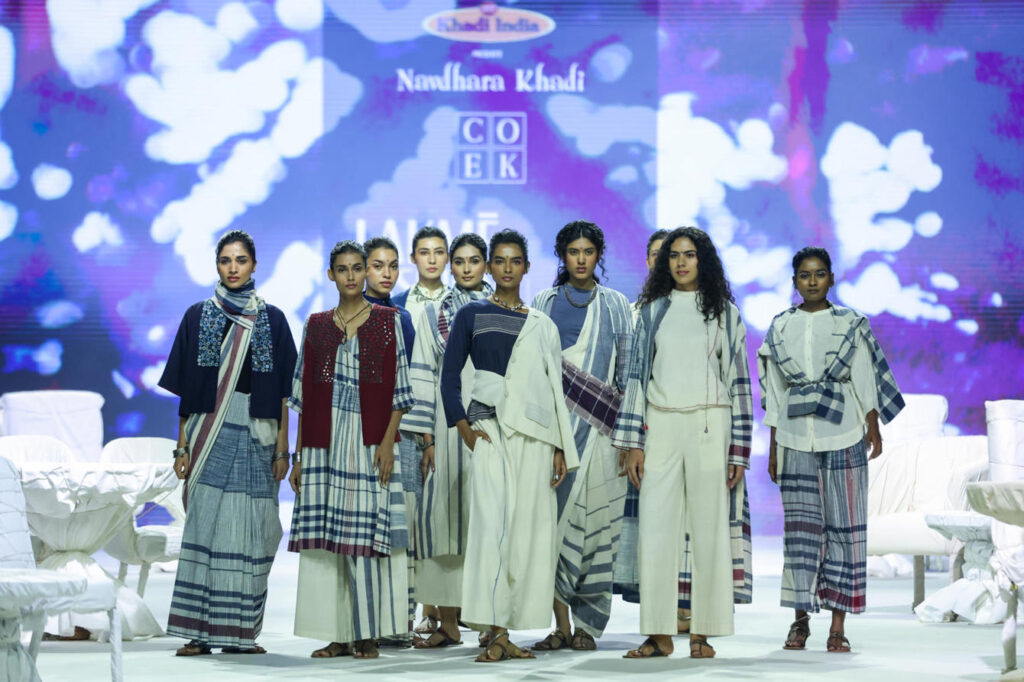
By spotlighting textiles developed at Sandur Kushala Kala Kendra, the collection emphasized process over personality—indigo, kora, and madder tones reinforcing a quiet, almost anti-fashion stance. In an industry driven by individual creative authorship, this model suggests an alternative: institutional design development.
If scaled correctly, CoEK could become the backbone of khadi’s consistency problem—standardizing quality while preserving craft integrity.
Pawan Sachdeva: Khadi Denim and the Streetwear Bridge
Pawan Sachdeva’s “Swadeshi” might be the most strategically relevant collection in the lineup. Khadi denim is not just a design experiment—it’s a category play.
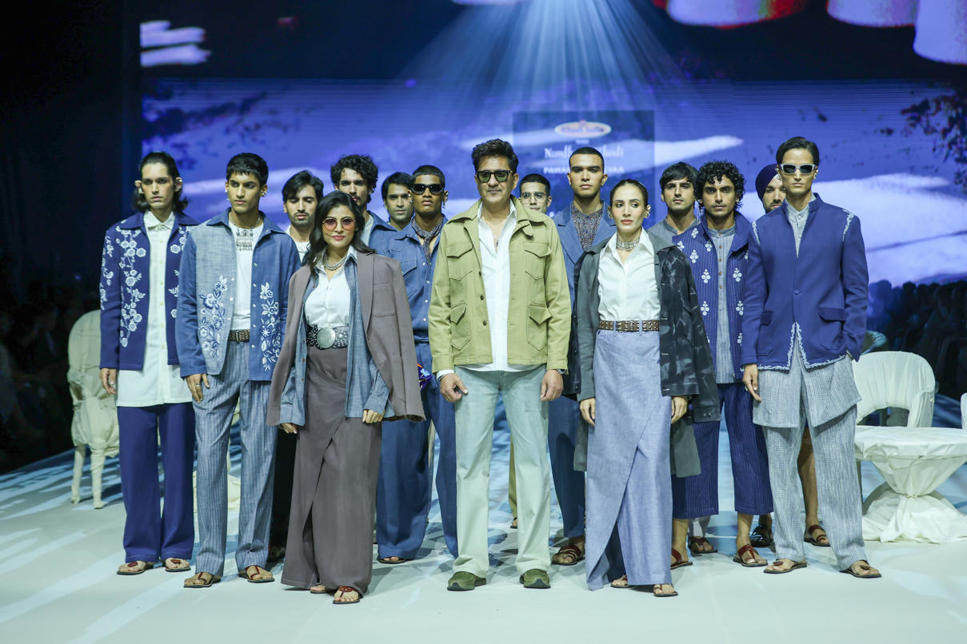
By introducing organic washes and surface techniques, Sachdeva tapped into a language the global market already understands: denim.
This is where khadi becomes accessible.
Because while heritage narratives are powerful, familiarity drives adoption. If khadi can live within existing categories like denim, it bypasses the need for consumer education and enters wardrobes more seamlessly.
Shruti Sancheti: Craft Density Meets Narrative Layering
Shruti Sancheti’s collection leaned fully into craft density—multiple khadi varieties (Nasi, Gecha, Dupion, Mulberry) layered with silk, wool, linen, and cotton.Add to that Nagpur checks, stripes, Gond and Warli motifs, and the result is a deeply narrative-driven collection.
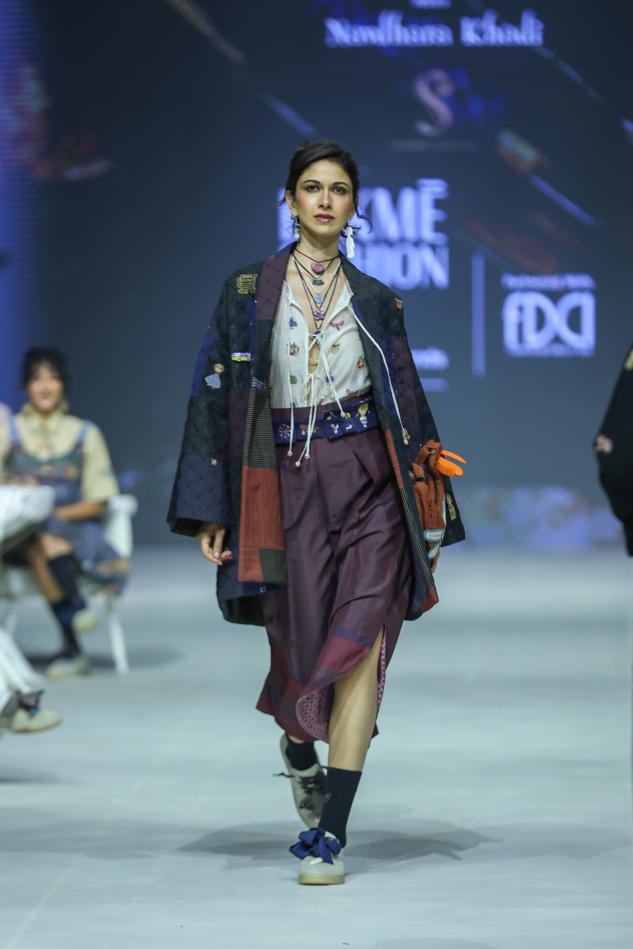
From an editorial standpoint, it’s rich. From a commercial standpoint, it raises a familiar challenge: complexity.The more layered the storytelling, the harder it becomes to scale production without dilution. But as a cultural archive on the runway, this was one of the strongest statements of the show.
The Larger Industry Play: Can Khadi Finally Scale?
Navdhara Khadi succeeds in one crucial area—it shifts the conversation from “why khadi matters” to “how khadi can compete.”
But the industry challenge remains structural:
- Can supply chains support consistency at scale?
- Can designers maintain texture integrity in bulk production?
- Can pricing align with both artisan wages and global retail expectations?
Because runway validation is only step one. Market adoption is where most craft narratives collapse.
FH Insight
Navdhara is not just a showcase—it’s a test case.
For years, khadi has been protected by sentiment. Now, it’s being exposed to market logic. And that’s a good thing.If khadi is to survive beyond government backing and cultural symbolism, it needs exactly this kind of pressure—designers treating it not as heritage, but as material.
The moment khadi stops asking for respect and starts demanding desire, its global relevance truly begins.