Editorial
The 2010s are Calling: Dior AW 2026 Just Made the Peplum the Chicest Silhouette
At Dior AW 2026 show in Paris, Jonathan Anderson did something few designers attempt with conviction: he rehabilitated a silhouette the industry had quietly archived.
The peplum — long associated with early-2010s corporate dressing — re-emerged not as nostalgic revival, but as architectural proposition.
Anderson’s second ready-to-wear collection for the house signaled a clear direction. This is not archive repetition. It is structural recalibration.
A Promenade at the Jardin des Tuileries
Staged at the Jardin des Tuileries, the set resembled a floating promenade — a wooden deck laid across a reflective pond scattered with lily pads. The staging reinforced the collection’s underlying narrative: movement, display, observation.
The front row reflected the global scale of the house. Anya Taylor-Joy appeared in a fluid satin midi; Jisoo and Hyunjin drew significant crowds beyond the glass perimeter. Priyanka Chopra, Charlize Theron, Emily Ratajkowski, Jennifer Lawrence and Rihanna further underscored the show’s positioning as a key moment of Paris Fashion Week AW26.Play
But celebrity optics were secondary. The silhouette carried the weight.
Reconstructing the Peplum at Dior AW 2026
The success of this return lies in fabrication and proportion.
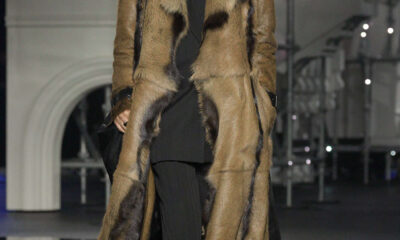
Material Shift The peplum appeared in distressed denim, shaved shearling, and dense knit constructions. By removing it from lightweight, overtly feminine textiles, Anderson stripped away its former officewear associations.
The Cardigan Intervention A collarless knit cardigan with a fluted hem referenced the house’s Bar Jacket lineage without direct replication. It reframed domestic softness into controlled structure.

Architectural Integrity These were not decorative ruffles. The flares were engineered, holding shape to carve a decisive waist. The result was an hourglass silhouette that felt assertive rather than ornamental.
Dual-Volume Dressing at Dior AW 2026
Where the collection sharpened its argument was in proportion play.
Instead of the conventional “fitted versus voluminous” balance, Anderson layered volume against volume. Peplum tops met ballooned skirts, puffed trousers, and trailing trains reminiscent of aquatic forms. The waist became a hinge point between two expanding forms.
This dual-volume approach reframes femininity as spatial control rather than reduction. It rejects minimal restraint in favor of constructed presence.
Why It Works Now
The early 2010s peplum failed because it felt additive — an extra frill placed onto an otherwise standard garment. Here, it functions as a structural device. It reshapes the garment’s architecture from within.
Under Anderson’s direction, the house is not reviving trends for cyclical nostalgia. It is extracting silhouettes from the past and stress-testing them against contemporary proportion theory.
The result positions the peplum not as a retro indulgence, but as a viable 2026 framework — one built on structure, density, and controlled exaggeration.
If the 2010s are calling, Dior has answered — but on its own terms.